The correct electrode depends on more than the metal label on the package. You need to match the base-metal chemistry, joint restraint, welding position, power source, thickness, service conditions and governing procedure before choosing a diameter or brand. By the end, you will have a practical sequence for comparing classifications, current ranges, storage requirements and supplier documentation.
Key takeaways
- Match the electrode to the base metal, service condition and governing code.
- Read AWS classification markings for strength, position, polarity and moisture requirements.
- Set electrode diameter, amperage and polarity together for the welding position.
- Check the WPS, PQR, packaging, batch details and jobsite storage conditions before welding.
Start with the base metal, service condition and governing code
Identify the base metal, service condition and governing code before comparing electrode diameters or brands. A compatible classification alone does not satisfy code-controlled work; the consumable must match the material specification and the qualified WPS and PQR.
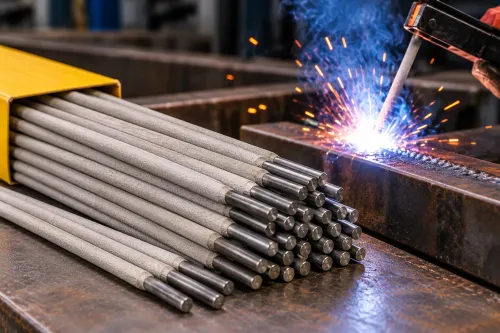
- Carbon steel calls for carbon steel electrodes covered by AWS A5.1; low-alloy steel electrodes fall under AWS A5.5 and must match the weld-metal alloy and heat-treatment regime.
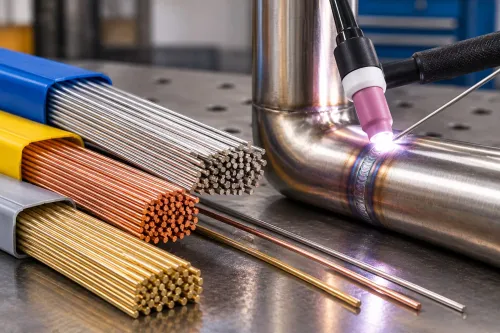
- Stainless steel electrodes follow AWS A5.4. Use 308L for 304/304L and 316L for 316/316L when the service and procedure support them. For stainless-to-carbon joints, 309L often tolerates dilution better, but the dissimilar-metal WPS must govern.
- Cast iron electrodes are covered by AWS A5.15. Nickel-rich grades favour machinability; nickel-iron grades favour strength and difficult joint conditions.
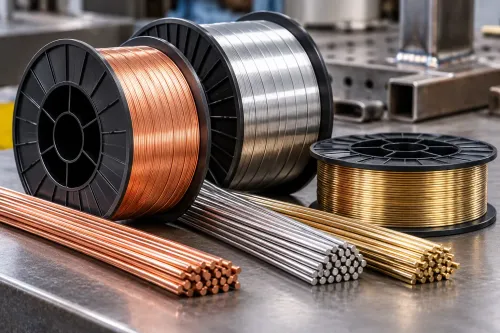
- Aluminium welding electrodes follow AWS A5.3. Copper welding rods need a filler specification suited to the copper alloy, joint temperature and conductivity.
- Hardfacing electrodes are selected for the wear mechanism—abrasion, impact, metal-to-metal wear or corrosion—not merely the substrate.
2. Check service temperature, corrosion, loading, restraint and cracking risk. For restrained steel, verify low-hydrogen storage, cleaning, preheat, interpass temperature and heat input; the electrode alone cannot prevent hydrogen cracking.
3. Reject any choice that conflicts with the governing code, project toughness or heat-treatment requirements. AWS A5.1, AWS A5.3, AWS A5.4, AWS A5.15 and AWS A5.5 are starting points, not substitutes for the qualified procedure.
Read the electrode classification instead of treating it as a product number
The E6013 meaning is built into its characters: “E” means electrode, “60” indicates 60 ksi minimum tensile strength, “1” indicates all-position welding, and “3” identifies the coating type and current characteristics. It is not simply a product number.
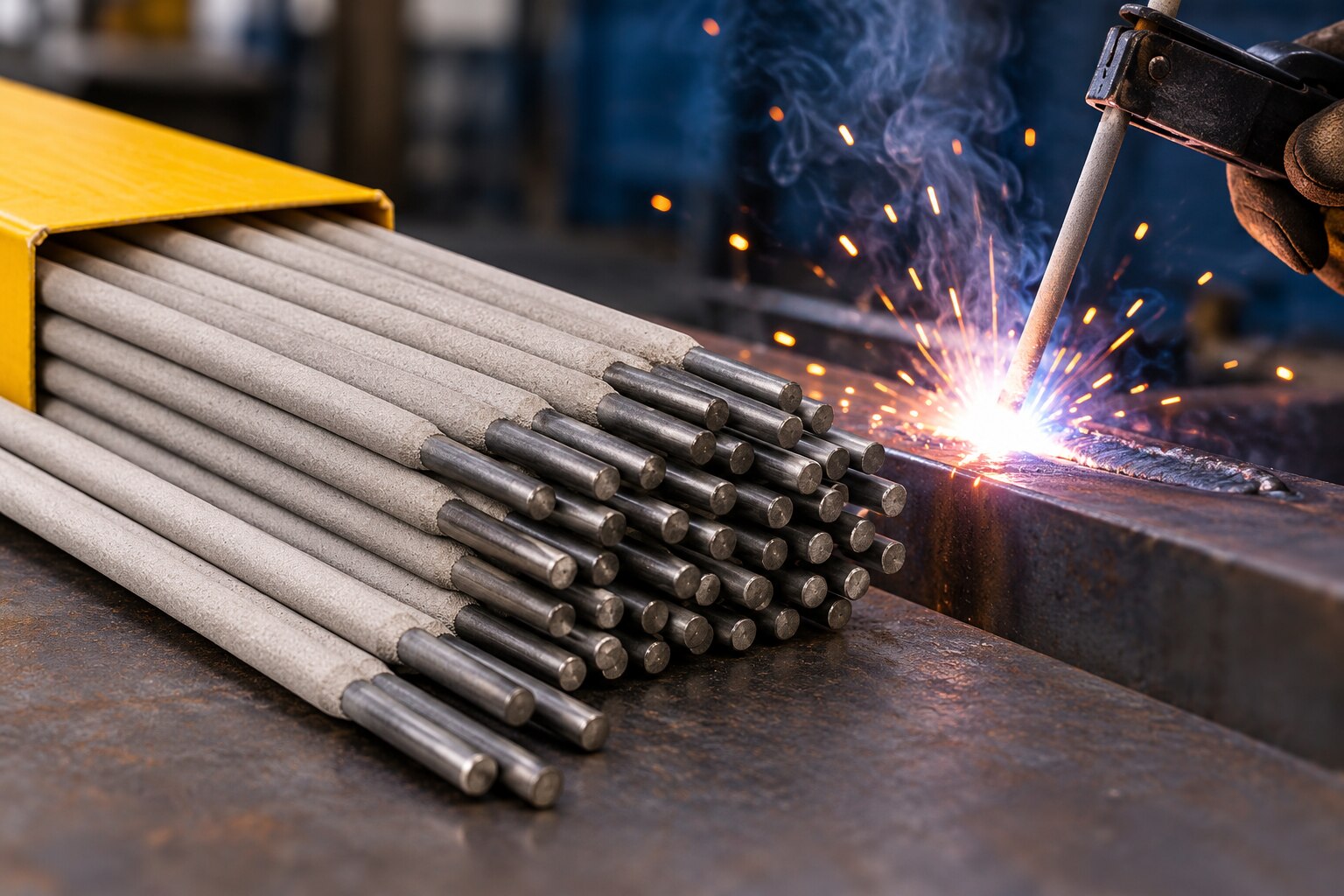
- E7018 meaning: 70 ksi minimum tensile strength, all-position welding, and a low-hydrogen electrode with an iron-powder coating for AC or DCEP. The “8” also identifies the coating and current system.
- E11018M: 110 ksi minimum tensile strength, all-position capability, low-hydrogen iron-powder coating, and additional controlled moisture and hydrogen requirements signalled by “M”.
- E6010 and E6011: cellulose-coated electrodes designed for deep penetration and root work; E6010 uses DCEP, while E6011 also runs on AC.
- E7024: iron-powder coating and high deposition rate, but welding position is normally limited to flat welds and horizontal fillets.
- E308H welding electrode meaning: an austenitic stainless classification with higher carbon than standard E308 variants; confirm the complete suffix and chemistry before welding stainless steel.
- ENi-1: a nickel electrode classification for selected nickel and cast-iron repairs. Its tensile strength and yield strength are not stated by the name; check the deposited-metal certificate.
Do not assume every E7018 is equivalent. H4 and H8 identify maximum diffusible hydrogen levels in millilitres per 100 g of weld metal, with H4 stricter than H8. Compare the code, coating condition and required welding position.
Choose diameter, amperage and polarity as one setting decision
Choose diameter, amperage and polarity from the joint’s heat demand, not rod size alone. Start with the root gap, base-metal thickness, welding position and power source. A tight root gap needs a smaller electrode and controlled current; a wide gap or heavy fillet can accept a larger rod.
Confirm electrode compatibility with the base metal, coating classification and machine output before striking.
| Diameter and typical starting current | Joint decision | What to watch |
|---|---|---|
| 2.5 mm welding electrode amperage: 60–90 A | Root passes, thin sections, tight gaps and positional work | Too much current burns through; too little causes poor arc starting and lack of penetration |
| 3.15 mm electrode current: 90–130 A | General fillets and medium-thickness joints | Raise current only until the arc is stable and the bead wets both toes |
| 4.0 mm electrode amperage: 130–180 A | Thick plates, long fillets and high deposition | Excess heat enlarges the bead, distorts thin edges and reduces positional control |
Treat these figures as starting windows, then follow the electrode maker’s data and qualified WPS. Polarity changes the result: E6010 normally needs DCEP for its forceful, deep-penetrating arc, while an AC welding electrode such as E6011 suits AC or DCEP.
DCEN can produce a cooler workpiece response, but check the classification before using it; polarity affects arc starting, penetration and bead shape. Switch rods rather than forcing current outside the recommended range.
Match the rod to welding position, restraint and hydrogen risk
Position decides whether the weld pool stays where you place it. Use this guide:
| Position | Electrode choice | Why it fits |
|---|---|---|
| Flat welding | E7024 flat welding electrode | High deposition rate; do not use it for vertical or overhead work. |
| Horizontal welding | E7024 horizontal welding electrode | Suits horizontal fillets, but not all-position joints. |
| Vertical or overhead | E7018 or another all-position electrode | Better control than E7024; follow the classification and polarity. |
| Open-root pipe welding | E6010 on DCEP; E6011 on AC or DCEP | Cellulose coatings provide a forceful, deep-penetrating arc for the root. |
Highly restrained, thick or crack-sensitive carbon-steel and low-alloy-steel joints need a dry low-hydrogen system. Keep E7018 storage electrodes sealed, use them within the manufacturer’s exposure limit, and rebake them only at the specified temperature and time. A damp rod can contribute to hydrogen-induced cracking.
Remove oil, paint, rust and moisture before welding. E7018 gives a smoother, lower-penetration arc but is a poor answer for contaminated surfaces or a digging open root; clean the joint instead of relying on E6010 or E6011. Set preheat, interpass temperature and heat input from the qualified WPS, especially on thick, restrained parts.
A low-hydrogen electrode alone cannot prevent cracking.
Use the right filler for stainless, cast iron, aluminium and wear repairs
Choose specialised filler by base-metal chemistry and service failure, not by a general-purpose electrode label.
| Base metal or problem | Starting choice | Selection reason |
|---|---|---|
| 304 stainless | 308L electrode | Matches 304/304L; its low carbon content reduces sensitisation risk during welding. |
| 316 stainless | 316L electrode | Matches 316/316L and supports corrosion-service evaluation after welding. |
| Stainless to carbon steel | 309L dissimilar metal welding | Higher chromium and nickel improve dilution tolerance; assess galvanic corrosion stainless to carbon steel. |
| Cast iron | ENi-CI or ENiFe-CI cast iron welding | ENi-CI is easier to machine; ENiFe-CI provides higher strength and better joint tolerance. |
| Aluminium | Aluminium GTAW or GMAW filler wire | Conventional SMAW electrodes are unsuitable; remove oxide and control heat input. |
| Wear repair | Hardfacing selected for abrasion, impact, erosion or corrosion | Hard deposits resist abrasion, while tougher deposits better tolerate impact and cracking. |
The L designation reduces sensitisation risk; it does not replace heat-input control, interpass limits, cleaning or a corrosion review. A 309L deposit can tolerate dilution without eliminating galvanic corrosion or qualifying every dissimilar joint, so follow the approved WPS/PQR.
For cast iron, preheat, short beads, controlled interpass temperature and slow cooling often matter more than diameter. For hardfacing, choose the dominant wear mechanism first: a very hard overlay can crack under impact or resist machining, while a tougher alloy can wear faster under severe abrasion.
Verify the purchase against the procedure and the jobsite
Before accepting an electrode for production, compare its paperwork with the qualified WPS/PQR and governing material specification; AWS classification alone is insufficient. Confirm the jobsite can meet the procedure’s controls.
1. Ask for the welding electrode batch number, AWS classification verification, and certificate of conformity naming the applicable AWS specification and project requirements.
2. For low-hydrogen rods, request a diffusible hydrogen certificate, confirm H4 or H8, and verify the electrode storage oven meets procedure controls.
3. Inspect electrode packaging for intact seals, legible lot details and moisture damage; confirm diameter, polarity, current, position and preheat controls. RND Welding Pvt Ltd, a welding consumables supplier in Mumbai, can help reconcile these documents before receipt.
Related products
 | Welding Electrodes Size 2.5mmX350mm Material Copper Certification AWS CE ISO Operating Current AC/DC Application/Usage Automotive Welding current range 120 A... View product → |
 | Welding Electrodes Material Mild Steel Length 350 mm Size 3.15 mm Brand Lincoln Model Name/Number Conarc 80 Diameter 3.2mm Established in the year of 2018, RND Welding... View product → |
Frequently asked questions
What should you check before choosing a welding electrode?
Identify the base-metal specification, service conditions and governing code, then compare the electrode with the qualified WPS and PQR.
What do welding electrode classification numbers tell you?
The classification identifies properties such as tensile strength, yield strength, coating type, welding position and required polarity; it is not merely a product number.
How do electrode diameter, amperage and polarity work together?
Choose them as one setting decision based on material thickness, welding position, joint access and the electrode manufacturer’s operating range.
Which filler should you use for stainless steel, cast iron, aluminium and wear repairs?
Use a filler designed for the specific alloy and repair objective, then verify compatibility with the service environment, preheat requirements and approved welding procedure.
Related products
 | Welding Electrodes Diameter 2.5 mm X 450 mm Material Stainless Steel Size 2.5,3.15,4.0mm Electrode Length 350/450 mm Application/Usage Construction Brand ESAB Welding... View product → |
 | Welding Electrodes Diameter - 2.5/3.15/4.00mm Material Mild Steel Operating Current AC/DC Application/Usage Construction Packaging Type Box Length - 350/450mm We are... View product → |
 | Stainless Steel Welding Electrodes ₹ 3,800/KgGet Latest Price Length 350 mm Material Stainless Steel Operating Current AC/DC Brand Arocos Size 3.15 mm Application/Usage Construction We... View product → |
 | Stainless Steel Welding Electrodes ₹ 130/KgGet Latest Price Size/Diameter 2.5 mm Material Mild Steel Brand Ador Size 2.5 mm Length 350 mm Application/Usage Construction We are leading... View product → |