Choosing flux-cored wire for a vehicle repair starts with the steel, joint thickness and welding process—not the spool diameter alone. By checking the AWS classification, shielding gas, machine setup, wire size and storage condition, you can specify a product that suits the repair instead of risking burn-through, porosity or a weak structural joint.
Key takeaways
- Use flux cored wire for thick structural steel, not thin body panels.
- Read the full E71T-1 suffix, including its shielding-gas designation.
- Choose wire diameter by sheet thickness, joint access and heat control.
- Keep spools sealed and dry in Mumbai’s humid workshop conditions.
Match the wire to the automobile repair job
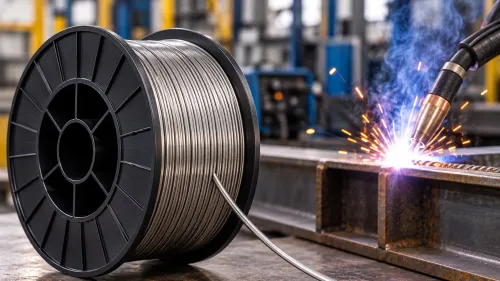
Use flux cored wire for automobile repair when the joint is thick enough to tolerate its heat and slag, such as chassis sections, frame repairs, suspension mounts, heavy brackets and other carbon-steel structural parts. A qualified procedure and competent welder are essential for crash-relevant joints; an E71T-1 label alone does not approve that repair.
| Job | Suitability | Main limitation |
|---|---|---|
| Chassis or frame section | Suitable with a qualified procedure | Verify steel grade, joint design, preheat, heat input and inspection |
| Suspension mount or heavy bracket | Suitable for compatible carbon steel | Poor fit-up or excessive heat can cause distortion or a weak joint |
| Body panel or thin sheet | Possible with 0.8 or 0.9 mm wire and controlled short welds | Slag, burn-through and distortion make solid-wire GMAW the easier choice |
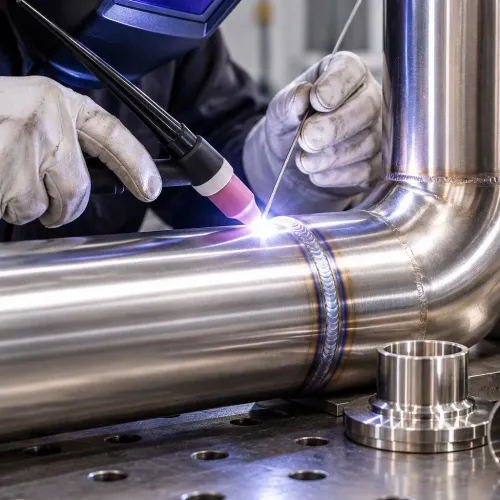
| Exhaust tubing | Suitable for thicker repairs or brackets | Thin tubing burns through easily; replacement or TIG may be safer |
| Crash-relevant structure | Only under an approved repair procedure | Do not select wire from tensile strength alone |
Gas-shielded E71T-1 requires the shielding gas, polarity and parameters specified by its manufacturer, commonly an argon-carbon-dioxide mix or carbon dioxide. It is not interchangeable with self-shielded E71T-11: changing wire changes shielding, fumes, slag behaviour and machine settings.
Reject flux cored wire for automobile repair when the panel is too thin, access prevents proper shielding, the machine cannot feed the selected spool, or the repair demands minimal cosmetic cleanup and distortion. A worn liner, wrong drive-roll groove or excessive spool drag can turn a sound choice into burnback or bird-nesting.
Read the complete E71T-1 classification before buying
An E71T-1 label is incomplete unless it shows the full AWS A5.20 classification, such as E71T-1C or E71T-1M. The label identifies a flux-cored electrode with a nominal 70 ksi minimum tensile-strength category; the “1” indicates all-position capability within the classification system, not approval for a crash-relevant repair.
Verify these purchasing details before accepting a spool:
- Complete classification, including C or M, any impact-test suffix, and hydrogen designation such as H8
- Nominal diameter and spool or drum mass
- Required shielding gas, polarity, voltage, wire-feed speed and gas-flow range
- Manufacturer’s parameter table and the applicable welding procedure
| Label or wire type | Shielding and normal setup | What you must not assume |
|---|---|---|
| E71T-1C | 100% carbon dioxide; normally DCEP | One universal voltage or gas-flow setting |
| E71T-1M | Argon/carbon-dioxide mixture; normally DCEP | That it performs like a CO₂-only product |
| E71T-11 | Self-shielded flux core; no external shielding gas | That it is interchangeable with E71T-1 |
A search for flux core wire e71t 1 can return self-shielded products, so read beyond the first matching words. Gas-shielded E71T-1 needs a regulator, flowmeter and wind protection; substituting self-shielded wire changes polarity, fumes, slag and parameters.
Tie a chassis or suspension-mount repair to a qualified procedure and competent welder, not to the E71T-1 label alone.
Choose wire diameter by sheet thickness and heat control
A 0.8 mm or 0.9 mm wire gives the best heat control on thin body panels. A 1.2 mm wire deposits more metal and demands higher current, so it can burn through panels, enlarge the heat-affected zone and distort doors, guards or fenders.
| Wire diameter | Best fit | Heat-control decision |
|---|---|---|
| 0.8 mm | Very thin body panels and small patch repairs | Use short stitches and low wire-feed speed to prevent burn-through |
| 0.9 mm | Most body-panel repairs and light brackets | A practical balance of penetration, deposition and control |
| 1.0 mm | Medium brackets, mounts and thicker repair sections | Use when 0.9 mm lacks deposition, while controlling bead length |
| 1.2 mm | Thick brackets, chassis rails and structural sections | Reserve for adequate thickness, machine capacity and a qualified procedure |
Do not run a continuous bead across thin automotive sheet. Tack the patch, check fit-up, then use staggered short welds with cooling pauses; long beads can warp the panel even with the correct classification.
Your flux cored wire size requirements are incomplete unless they state nominal diameter, AWS A5.20 classification, shielding gas, polarity and the approved parameter range.
For a chassis, suspension mount or crash-relevant joint, follow a qualified welding procedure that accounts for steel grade, thickness, joint design, preheat and inspection; selecting 1.2 mm solely because the joint is structural is unsafe.
Specify the welding machine, gas and operating setup
A machine’s maximum amperage is not enough: its feeder, duty cycle and output range must cover the selected wire’s parameter table. Check that the machine accepts the spool mass and hub size, delivers the required voltage and wire-feed speed, and sustains the target current without overheating during repeated chassis or bracket welds.
Match the machine and torch to these items:
- Polarity: Gas-shielded E71T-1 normally uses direct current electrode positive (DCEP). Follow the full classification and manufacturer’s datasheet; a self-shielded wire can require a different polarity.
- Liner: Fit a clean liner rated for the wire diameter, with the shortest practical torch path. A long, kinked or poorly supported liner makes 1.2 mm wire drag, bird-nest and burn back.
- Contact tip: Use the manufacturer’s tip size for the nominal diameter. Replace a tip that is oval, blocked or loose; excessive clearance causes an erratic arc.
- Drive rolls: Install the recommended knurled or flux-cored roll in the correct groove, then set pressure high enough to feed without crushing the wire.
- Duty cycle: Choose the machine’s rated duty cycle at your actual amperage, not its peak output. A small inverter can trip its thermal protection before a long repair is complete.
For gas-shielded wire, specify the suffix and equipment together: E71T-1C uses 100% carbon dioxide, while E71T-1M uses an argon/carbon-dioxide mixture. Use a cylinder, regulator-flowmeter, hose, solenoid and leak-free connections; set flow from the datasheet and protect the arc from drafts.
Buy and store the spool correctly in Mumbai
Ask a flux cored wire supplier in Mumbai to document the exact spool you will receive, not merely quote “E71T-1.” Your written specification for flux cored wire for requirements in mumbai should identify:
- Sealed, moisture-resistant original packaging and the spool or drum mass
- AWS A5.20 or ISO classification, nominal diameter and shielding-gas requirement
- Lot or heat number, manufacturer, and manufacture date where provided
- Polarity, required hydrogen designation where applicable, and the manufacturer’s voltage, wire-feed-speed and gas-flow table
- Storage instructions, shelf-life information and the approved welding procedure for safety-critical repairs
RND Welding Pvt Ltd is one supplier you can ask to match the invoice, label, lot number and parameter sheet before accepting delivery. Tie a chassis or suspension-mount purchase to a qualified welding procedure; a correct classification alone does not prove suitability for the steel grade, thickness or joint.
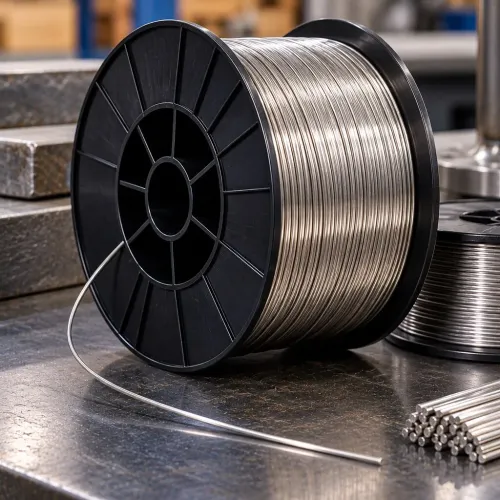
Keep unopened spools in their original sealed packaging in a dry indoor store, raised off the floor and away from open doors, wash areas and salt-laden coastal air. After opening, cover the spool against condensation, dust and humidity, and close the package whenever welding stops.
Reject a spool with a broken seal, crushed flange, missing label, wet surface, rust, white powder or embedded dirt. During welding, rust or contamination can produce poor arc stability, excessive porosity, bird-nesting or burnback; do not try to cure those symptoms by changing voltage alone.
Related products
 | Welding Electrodes ₹ 150/KgGet Latest Price Material Mild steel Thickness 1.2 mm Wire Material MS Grade 71T1 Brand Kobelco Quantity Per Roll 15 kg Established in the... View product → |
 | Welding Electrodes ₹ 800/KgGet Latest Price Material Flux cored wire Thickness 1.2 mm Wire Material SS Grade FC 308l Brand Taseto Quantity Per Roll 12.5 kg Established... View product → |
Frequently asked questions
Which automobile repairs suit flux cored wire?
Use flux cored wire for thicker carbon-steel structural work such as chassis sections, frame repairs, suspension mounts and heavy brackets. It is a poor first choice for thin body panels because heat input and slag increase distortion and cleanup.
What does the E71T-1 classification mean?
In E71T-1, E identifies an electrode, 7 indicates a 70 ksi minimum tensile-strength class, 1 indicates all-position capability, and T identifies a tubular electrode. The final usability designation must be read with the complete manufacturer classification, including any C or M shielding-gas suffix.
How do you choose flux cored wire size for automobile repair?
Match diameter to the steel thickness, joint design and machine output. Smaller wire gives better control on thinner sections and awkward access; larger wire deposits faster but raises heat input and risks burn-through or distortion.
What machine and gas setup does E71T-1 wire require?
Confirm the wire data sheet before setting the machine. Gas-shielded E71T-1 wire commonly uses DCEP with carbon dioxide or an argon-carbon-dioxide blend, but the permitted gas and polarity depend on the complete classification. Set voltage, wire-feed speed and gas flow from the manufacturer’s procedure.
How should you store flux cored wire in Mumbai?
Keep the spool in its original sealed packaging until use, store it above the floor in a dry area, and reseal or remove it from service if condensation, rust or contamination appears. Mumbai humidity makes exposure control important.
Keywords